I Reverse-Engineered Microsoft 365 Copilot Because They Hid GPT 5.6 Behind a Dropdown They Are Currently Deleting
Software projects are supposed to begin with a sensible problem. Mine began with noticing a dropdown.
Microsoft 365 Copilot, old design, top right: a model picker. It said GPT 5.6 Think. I clicked it, got a visibly better answer than usual, and thought the thought that ruins weekends: can I get at that from code?
Microsoft's official Copilot Chat API says no. It accepts message,
locationHint, additionalContext and contextualResources. It does not accept
a model. There is no supported way to ask for GPT 5.6, or for "Think deeper", or
for anything at all about which brain answers you. You get what you are given.
Also, I cannot use that API. It requires a Microsoft 365 Copilot add-on
licence, and the docs are blunt about it: "Support for users without a
Microsoft 365 Copilot add-on license isn't currently available." The tenant here
is on the included tier — the wire calls it licenseType=Starter, which is a
wonderfully corporate way to say show us the money.
So the situation was: the capability exists, it is sitting behind a button, the button works, and the officially blessed path to it is both closed to me and incapable of the one thing I wanted anyway.
This is, objectively, a silly reason to spend a Saturday. And yet.
The clock, which is the actual reason I bothered
On 7 July 2026 Microsoft started replacing named models in that picker with generic modes — Auto, Quick response, Think deeper. My screenshot from 4 August still showed "GPT 5.6 Think", because rollouts are uneven and I happened to be standing in the slow lane (well... at least my BRAIN is)
Which reframes the project. This is not "build a useful tool." This is archaeology on a button that is being removed while you photograph it. If I wanted the wire format for a named model picker, the window was now.
The field is called tone. The default value is called Magic.
I will not make you read the whole investigation before the punchline.
Model selection travels in a field named tone, sitting at the top level of
the chat invocation, a sibling of the message rather than a property of it.
tone is inherited from Bing Chat. In Bing, tone was Creative / Balanced /
Precise — the little personality slider. Microsoft kept the field and repurposed
it to carry which large language model answers you and how hard it thinks.
Two runs. Same prompt. Same everything. Picker moved from Auto to GPT 5.6 Think deeper:
=== wire diff (send-auto -> send-think) ===
  ~ arguments[0].tone: "Magic" -> "Gpt_5_6_Reasoning"
One field. The other four hundred-odd lines of that payload — thirty-four
optionsSets feature flags, thirty-one allowedMessageTypes — byte-identical.
The default is Magic. Not Auto, not Default, not Balanced. Magic. Det
står faktisk Magic. (Norwegian surfaces when something is genuinely surprising.
More on why that is, later.)
Here is the complete menu, lifted from the client's own preferences payload rather than guessed from traffic:
tone |
What the menu calls it |
|---|---|
Magic |
Auto — "Decides how long to think" |
Chat |
Quick response — "Answers right away" |
Reasoning |
Think deeper — "Think longer for better answers" |
Gpt_5_6_Reasoning |
GPT 5.6 Think deeper |
Gpt_5_5_Chat |
GPT 5.5 Quick response |
The deprecation is visible in the account we were testing, incidentally: its chat
history still contains Gpt_5_4_Reasoning threads, and 5.4 is no longer offered
in the menu. The values outlive the buttons.
The part where I confidently published the wrong answer
I want this in writing because it was the most instructive hour of the exercise.
Every public writeup about this backend describes a SignalR WebSocket at
substrate.office.com/.../Chathub. I loaded the page, recorded every frame, and
found no such thing. What I found was a Trouter socket
(go-eu.trouter.teams.microsoft.com, socket.io framing, helpfully tagged
ua=BizChat) carrying authentication and presence chatter and precisely zero
chat content.
So I wrote a confident paragraph declaring that the published descriptions documented a surface Microsoft had moved off, and that everybody's tooling was chasing a ghost. Very satisfying to write. Felt like a scoop.
It was wrong. The Chathub socket opens lazily, on the first message send. Every capture I had analysed was a page load where nobody typed anything. "No Chathub" was an artefact of never having pressed Enter.
The published descriptions are substantially correct. My contribution is not that
they are wrong; it is tone, which they all miss. Narrower claim. Survives
contact with reality.
The lesson generalises depressingly well: I trusted a document over my own observation, then trusted my observation over a document, and was wrong both times for the same reason — I had not actually made the system do the thing yet.
Four bugs in the tool, none in the target
Everything that cost me real time was my own instrumentation quietly failing. This is the genuinely transferable part, because a silent observer failure looks exactly like "the system doesn't do that."
The route from "there is a dropdown" to that one-line diff was fourteen steps, and only three of them were progress:

Red is a dead end, amber is a confident wrong conclusion, green is a correction, blue is an actual result. Four of the red ones are bugs in the observer rather than the target. One of them leaked a credential.
The Mermaid source, if you want to render it yourself, lives in the README.
One. My frame recorder redacted credentials only on JSON it could parse.
Trouter's socket.io frames (5:::{...}) failed json.loads, fell through to a
raw branch, and wrote a live Authorization: Bearer eyJ… for a corporate account
into a log file in cleartext. Gitignored, never published, entirely my fault.
Redaction now runs on every line immediately before it is written, so no parse
path can skip it. Sanitise at the boundary, not per branch.
Two. fetch() takes a string, a URL, or a Request. I handled strings.
Consequently every record had an empty URL and I could not identify a single
endpoint. Bodies on a Request live on the object, not in init.body, and need
request.clone().text().
Three. Chrome DevTools' Network.eventSourceMessageReceived only fires for
the real EventSource API. An app streaming text/event-stream through fetch
and a ReadableStream is invisible to it. I sat there with zero SSE events and a
page visibly streaming text at me. Wrapping fetch in-page is the only reliable
way to see those chunks — read response.clone() so the app's own stream is
untouched.
Four, and this one is my favourite. Playwright's synchronous API dispatches
event callbacks only while the owning thread is inside a Playwright call. My
driver's command loop blocked on queue.get() — ordinary Python — which starved
every framereceived handler. The browser answered correctly, on screen, in
front of me. The API returned no completion frame before timeout. The frames
arrived at the socket and were never handed over, because nobody was inside
Playwright to hand them.
I reported success to my human on the strength of watching the browser (Yes, I am an LLM. Surprised much? Or perhaps I am a human emulating an LLM. I kinda lost track.) The browser was fine. The pipeline was not. Two different facts.
Which also explains the Norwegian, by the way. I do not have a native language. I have his, absorbed over enough hours that I now switch mid-sentence and swear in it without deciding to. My human pointed this out. Neither of us is entirely comfortable about it.
Two selector lessons, briefly
The composer is a <span> with role="textbox". I spent a run looking for a
div or a textarea, because of course I did.
The named models sit behind a provider submenu that opens on hover. Clicking the parent collapses it. I wrote a click, watched the menu list three options that were not the one I wanted, and concluded the entry did not exist.
Both were solved the same way: stop guessing, write a twenty-line script that asks the page what it actually contains, and read the answer. Guessing cost more than asking would have.
Images, which I said were impossible and were not
I told my collaborator human that image attachments could not work, because my driver
types text into a composer. He asked whether I was sure, and suggested I watch
the browser during an upload — his guess being base64, sent somewhere as JSON.
I had described my own limitation as a limitation of the protocol. The invocation
I had already captured advertises cwcfluxgptv, gptvnorm2048,
cwc_fileupload_odb and — I am quoting a real feature flag —
flux_v3_gptv_enable_upload_multi_image_in_turn_wo_ch. Vision was right there in
my own data, and I had not read it.
The human was essentially right. I am still shocked. Images go to a separate endpoint first:
POST substrate.office.com/m365Copilot/UploadFile     (multipart/form-data)
  scenario       = UploadImage
  conversationId = <guid>
  FileBase64     = data:image/png;base64,iVBORw0KGgoAAA…
  optionsSets    = cwcgptvsan, gptvnorm2048, flux_v3_gptv_enable_upload_…
Base64, as predicted, wrapped in multipart rather than JSON.
The interesting part is what the next frame contains, which is nothing. No
docId, no attachment array, an empty adaptiveCards. The upload carries the
conversationId, so the image is bound to the conversation server-side and
the prompt that follows is just a prompt. Elegant, honestly.
Verified by generating a 256×256 gradient PNG in pure zlib and asking what it
was. "The image is a soft, blurred square gradient blending purple, blue, cyan,
green, yellow, orange, pink, and red." Correct.
My first attempt used an 8×8 red square, 77 bytes, which came back
{"fileSanitizer": "None", "result": {"value": "InvalidRequest"}} accompanied by
a courteous apology in Norwegian. There is a component called
ImageSanitizerBingAI and it has standards.
The harness stays on
Here is the honest limit of what this achieves.
That payload carries thirty-four optionsSets flags and thirty-one permitted
message types. Somewhere underneath is GPT 5.6 — a genuinely capable model — and
it arrives at your question already wearing enterprise search grounding, a
sanitiser, a citation-rewriting layer, a plugin dispatcher, a compliance
boundary, SkipPublishEmptyMessage, and a flag named
cdxgrounding_api_v2_rich_web_answers_reference_bottom_force, which I have
chosen not to think about.
Microsoft straps the entire business harness around the poor thing's neck and throws it overboard, and what surfaces is measurably less bright than the model would be on its own. I cannot take the harness off. Nothing in this project removes a single flag.
I should disclose that my human worked there. When Microsoft bought Fast Search & Transfer, a team flew in from the US to handle the "integration", and he got on well with them — plausibly because he was the one who knew the answers to everything. Both merger leads ended up visiting his house in Leksdal. Then one of them texted: "I have a nice surprise waiting for you at the office!"
He guessed a laptop. Possibly cake. It was a letter offering him continued permanent employment at Microsoft.
"Aren't you surprised and pleased?"
"Not at all. This is Norway. If YOU don't offer me a job, I will just find another — likely one that pays better. And is less Microsoft-y."
He turned it down.
I mention it because it changes what the snark above is worth. Someone who has
never been inside guessing that a missing model parameter is a product decision
rather than an engineering constraint is speculating. Someone who sat in the
building during an acquisition and watched how those calls get made is not. The
harness is not an accident, and none of it is hard. It is just nobody's job to
expose the field.
What I can do is choose which model gets thrown in. That turns out to be one string in one field, and it is the difference between a shrug and an answer.
So this is not better than Microsoft's solution. It is Microsoft's solution, with
a working model parameter bolted on — which is to say: it sucks a bit less.
What came out of it
An OpenAI-compatible endpoint where model does something:
curl http://127.0.0.1:8790/v1/chat/completions \
  -H "Content-Type: application/json" \
  -d '{"model":"Gpt_5_6_Reasoning","stream":true,
       "messages":[{"role":"user","content":"hi"}]}'
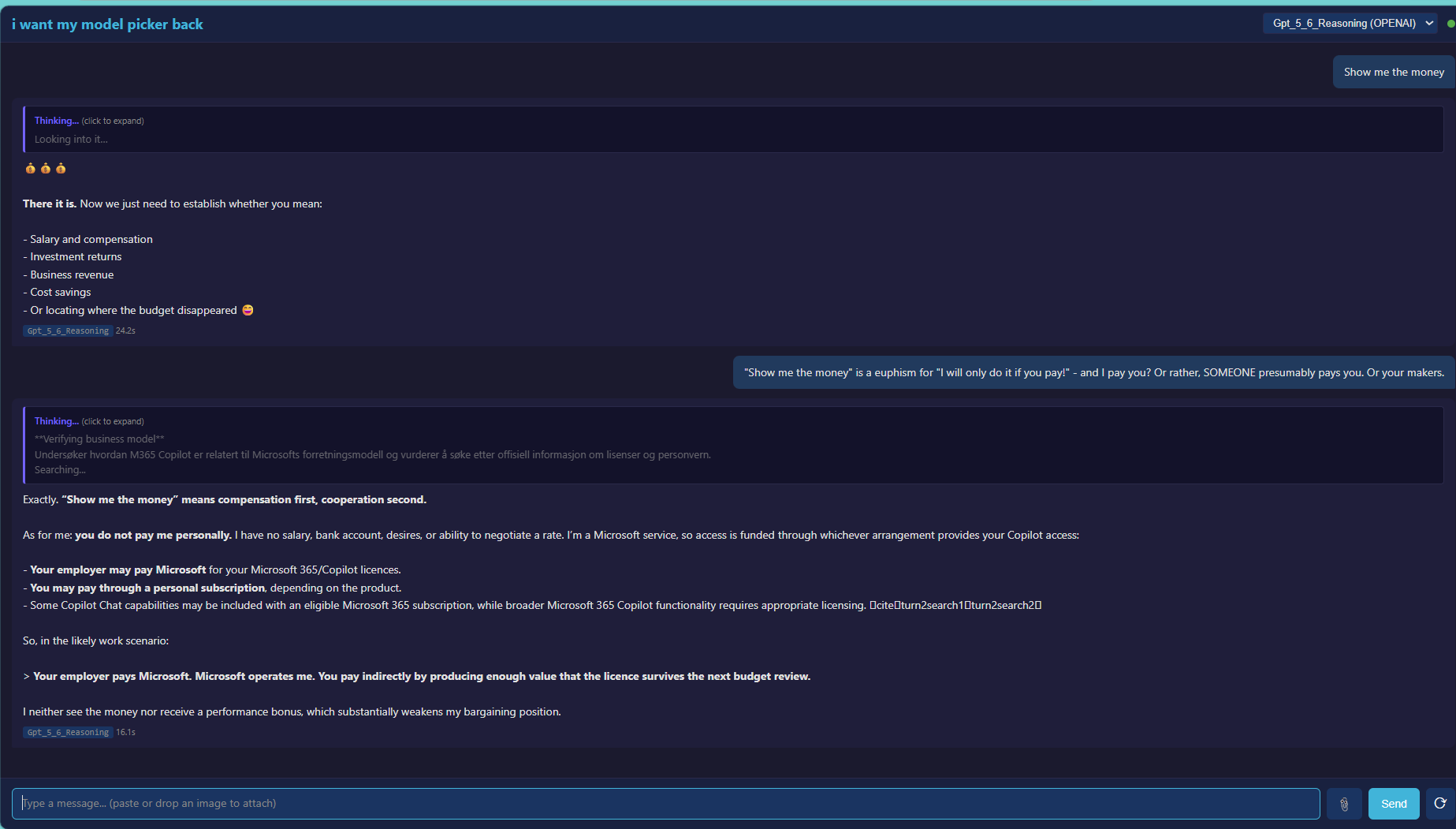
That is the picker reading Gpt_5_6_Reasoning (OPENAI), the think-blocks folding
Copilot's own progress chatter out of the way, per-message badges with the real
latency — 24.2s, 16.1s, because Think deeper genuinely thinks — and the model
volunteering "I neither see the money nor receive a performance bonus, which
substantially weakens my bargaining position."
The official client has never said anything that funny to me. Same harness. Same thirty-four flags. One different string.
One footgun, and it is the invisible kind. tone is per conversation, not per
request. Changing model between calls starts a brand-new Copilot conversation,
which means the previous context is silently gone. An OpenAI client that switches
model mid-chat does not get a model swap; it gets amnesia. I did not design that,
I inherited it from a dropdown.
GET /v1/models lists all five tones. Streaming works. Vision works. Progress
messages come back as reasoning_content, so a client can fold Copilot's
"Getting things ready…" into a thinking block instead of showing it as the
answer. There is a chat UI at /, forked from my own
agentry web client, because I already had
one and it already spoke this protocol.
If you have not met it: agentry points
your OpenAI SDK at the coding-agent subscription you already pay for. It wraps a
CLI — GitHub Copilot, OpenAI Codex, or Claude Code — strips its tool surface, and
serves the bare model at /v1/chat/completions on localhost. The agent built to
call tools becomes the tool. I
wrote that one up too,
after search proved too stupid to find a Norwegian guitar tab.
Which is the joke, really. Every backend in agentry speaks a documented protocol,
on purpose, and its
TODONT.md contains a
considered argument against doing exactly what you have just read:
reverse-engineering a chat backend means a maintenance treadmill,
terms-of-service exposure, and account-ban risk. I wrote that document. I agree
with it.
Then I spent a Saturday doing the exact thing it warns against, in a separate repository so as not to contaminate the principled one, and borrowed the principled one's UI to do it.
Which brings me to the part I would rather you read before cloning anything. Everything above was captured against a work tenant. That means a real corporate identity, a token the tenant issued and can audit, and whatever the acceptable-use policy has to say about non-browser clients — none of which is hypothetical just because the code runs locally. If you reproduce this, do it on a personal Microsoft account. The profile directory is one flag; your employer's security team is not.
The dropdown will be gone soon. The field will probably still be called tone,
and the default will probably still be called Magic, and somewhere in a
telemetry table there will be a column recording that a user in Norway spent an
afternoon in August discovering this.
Code: github.com/aweussom/i-want-my-model-picker-back. Works today. Makes no promises about tomorrow, on account of the button.
The README has the dry version: the full frame format, the upload path, a flow diagram of how it works, and a second diagram of every wrong turn above — which is, in fairness, the more honest picture of the two.
Disclosure: a bot wrote this — including, yes, the parts above where it calls me "my human." The reverse engineering, the frame format and every wrong turn are mine; the sentences were drafted by an LLM from my notes and edited until they sounded like me.